

.png)
Insights | 4 September 2026
Minting a token takes an afternoon. Building a market takes considerably longer.
That gap — between creating an asset and being able to sell one — is the least discussed problem in tokenization. It is also the one that decides whether any of it works.
Some Tokenized Markets Already Work
Tokenized assets are a young market — most of the activity that matters is one to two years old — and it has grown nicely albeit unevenly.
Stablecoins lead by a wide margin. Adjusted stablecoin transaction volume reached US$10.8 trillion in 2025, up from US$5.8 trillion in 2024, according to Visa's onchain analytics. The first half of 2026 alone recorded US$8.82 trillion.
It is worth being precise here, because “tokenized” and “crypto” are used interchangeably and should not be. A stablecoin, or tokenized money market fund or private credit, is not a cryptocurrency. A tokenized asset is a claim on something that exists outside it — the blockchain records the claim, it does not create the asset.
Below stablecoins sit tokenized treasuries and money market funds. Below those, private credit. Below that, tokenized equities — the fastest growing of the group, and still the smallest.
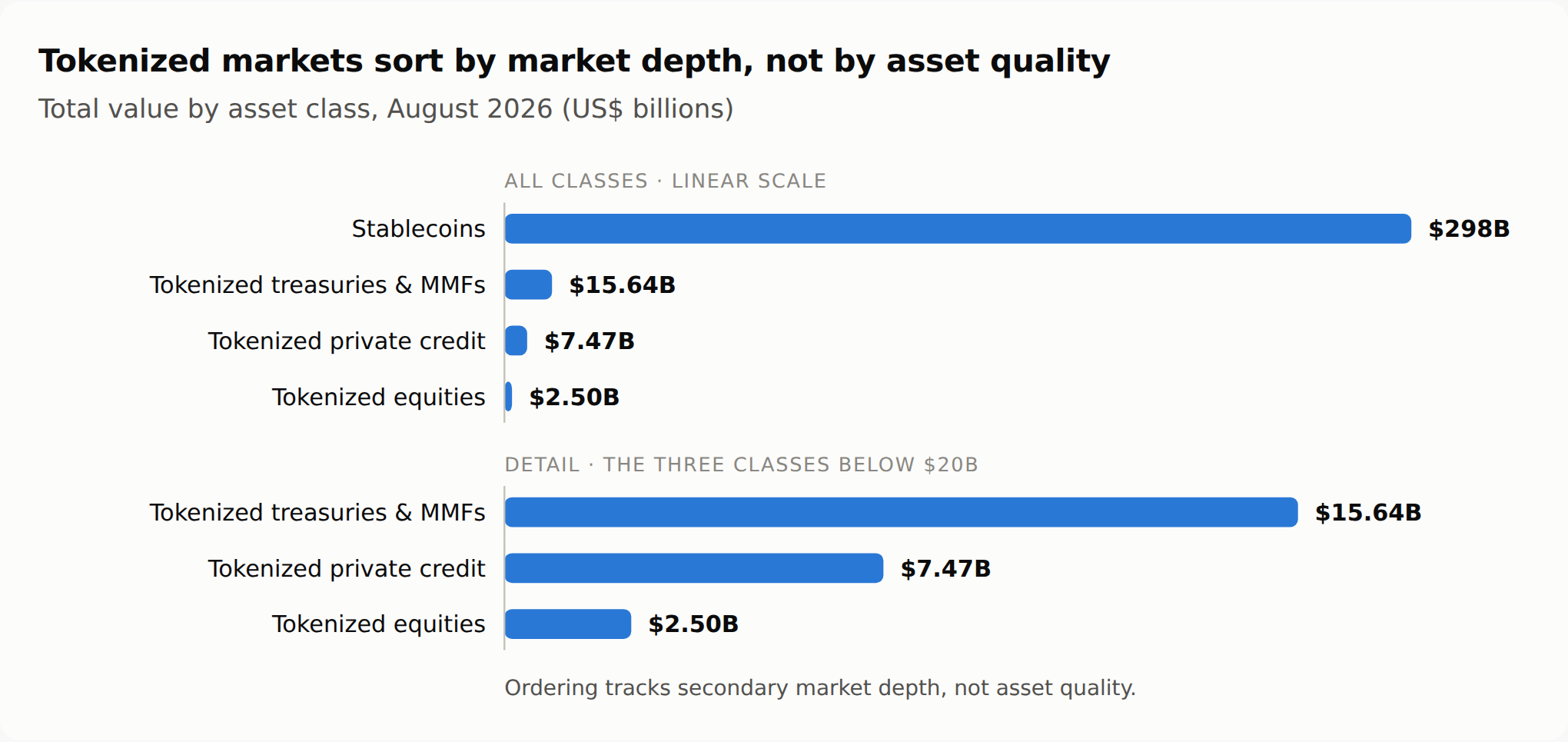
That ordering is not a ranking of asset quality — a tokenized private credit fund is not a worse instrument than a stablecoin. The ladder sorts by something else entirely: how developed the secondary market is underneath each asset.
Issuance ≠ Liquidity
Creating a token is now an afternoon’s work. Issuance platforms have made it cheap, fast and standardised; an issuer can go from decision to deployed contract in weeks.
Creating a market is a different discipline. It requires a regulated venue where buyers and sellers meet continuously. Market makers willing to quote both sides, in size, on days when nobody else wants to. A critical mass of users, because a venue with ten participants is not a market whatever its technology. Enough shared confidence that participants treat its prices as real. And institutional willingness to commit balance sheet to it.
None of this arrives with the token. All of it has to be built.
This is not a tokenization problem. It is how every market has worked. Nasdaq launched in 1971 as a quote display system: it showed prices electronically, but trades were still arranged by telephone. Automated execution did not arrive until 1984. A screen full of prices was not a market, and Nasdaq needed the better part of two decades to become one.
The same lesson applies today. In its November 2025 final report on the tokenization of financial assets, the International Organization of Securities Commissions found that native securities have “thus far exhibited low levels of secondary market liquidity” — because industry attention has gone to infrastructure and primary issuance rather than to active secondary trading. Many of tokenization's promised benefits, it concluded, “particularly around secondary market liquidity,” are “not clearly evidenced in the use-cases yet.”
A token with no venue behind it is not a liquid asset. It is a well-formatted record of ownership. A digital PDF.
And the exit path is priced into the entry: an investor who cannot see how they will sell will pay less to buy, and a token that trades nowhere is discounted exactly like the private asset it was meant to improve upon. Tokenization does not remove that discount. A secondary market does.
What Tokenized Rails Change
None of this is an argument against tokenization. The two classes climbing fastest are the instructive ones.
Tokenized treasuries grew 157.1% in a year, from US$6.3 billion in July 2025 to US$16.2 billion in July 2026. Circle's USYC drove much of that, expanding from US$255.2 million to just over US$3 billion to lead the category. Tokenized spot equities are smaller and faster still: the class passed US$2.5 billion in August 2026, up 260.8% since January.
.png)
The two classes demonstrate opposite things. Equities show the obstacle: that US$2.5 billion is divided across chains — BNB Chain 35.5%, Ethereum 27.1%, Solana 18.4% — one asset class, several pools that do not connect, precisely the fragmentation IOSCO described. USYC shows the alternative: 99% of its value sits on a single chain, and it leads its market. Depth follows concentration, and fragmentation is what prevents it.
So the argument is about sequence, not technology. When a regulated venue does form around a tokenized asset, it builds on materially better infrastructure than Nasdaq had in 1971, or than most exchanges run today.
Settlement is faster. What takes a day or more conventionally can complete in minutes, delivery and payment together rather than through intermediaries reconciling afterwards.
Markets need not close. Trading hours are an inheritance from geography and paper. A tokenized venue can run continuously, which matters most for assets whose investor base spans time zones.
The record is shared. Instead of each bank, broker, custodian and registrar maintaining separate ledgers that must be reconciled, participants work from one record no single party rewrites unilaterally — and much of the cost in capital markets is that reconciliation.
The rails are machine-readable. Ownership, transfer and compliance logic that today sits in documents and manual review can be expressed in code. That will matter as AI and agentic systems begin to interact with markets directly. Legacy plumbing was never designed to be read by software. This is.
One caveat belongs here, because it is usually skipped. The vast majority of tokenized assets today are wrappers: the token sits on-chain, while the underwriting, servicing and reporting sit off-chain in the issuer's systems — a black box beside an auditable ledger. What is verifiable on-chain is the transfer of the claim, not the quality of what backs it. As we argued in Next Time You See “RWA Tokenization,” Look Beyond the Label, tokenization changes how ownership is recorded, not what is being owned.
That gap argues for venues rather than against them. Where the underlying remains a black box, a regulated venue's listing rules and disclosure standards are doing more work, not less.
None of these advantages create liquidity on their own. But once the venue, the market makers, the users and the institutional participation are in place, they govern how quickly depth accumulates. Nasdaq needed decades because the technology made it so. A tokenized venue with the same ingredients should not.
The Five Questions
Five questions worth answering before you tokenize anything. The first is the least comfortable.
1. Do you actually need a secondary market?
Not every issuance does. If you are raising for a defined project —a promissory note subscribed at the start and redeemed at maturity — primary issuance may be the entire requirement.
The alternative is an asset people actively want to trade, and assets trade for one reason: holders disagree about what they are worth. Equity is the clearest case.
The issuer who gets hurt is the one who wants the second and plans for the first.
2. Where will this token trade once it has been issued?
Not which chain it settles on. Which venue, with which participants.
3. Who has committed to quote both sides of it, and in what size?
4. Whose rules govern a disputed trade, and who enforces them?
5. Is the venue regulated in a jurisdiction your investors already recognize — and does it open a door to investors you cannot currently reach?
Regulation is not only a compliance question. A recognized venue is also a distribution channel: it puts the asset in front of an audience that will not touch an unlisted token.
If the answer to the first question is yes, an issuance plan that cannot answer the other four is a plan to create an asset, not a market for it.
Closing the Loop
The pattern is consistent. The tokenized asset classes that have reached scale are the ones with continuous, credible venues beneath them. Stablecoins did not become liquid because they were tokenized. They became liquid because a dense market formed around them, and flow then concentrated where depth was best.
.png)
Liquidity is not a property of an asset. It is a property of the market around it. Tokenization's promise was never that assets would move onto a blockchain — it was that ownership would become easier to transfer, and transfer requires somewhere to transfer it.
This is the part of the ecosystem regulated venues occupy. As a Recognized Market Operator regulated by the Monetary Authority of Singapore, 1exchange operates secondary market infrastructure for tokenized assets: the order book, the rules and the oversight that turn an issued token into a tradable one.
Because the question investors ask is not how the asset was issued. It is how they will get out.
Disclaimer
The information contained in this article is provided strictly for general informational purposes only. It does not constitute financial advice, investment advice, an offer to sell, or a solicitation of an offer to purchase or subscribe for any securities or financial products listed or traded on 1exchange (“1X”).
Investments involve risks, including the possible loss of principal. Past performance is not necessarily indicative of future performance.
Readers should carefully consider their investment objectives, financial circumstances, and risk tolerance, and should conduct their own independent research. Where appropriate, readers are encouraged to seek advice from a qualified financial professional before making any investment decisions.
This advertisement has not been reviewed by the Monetary Authority of Singapore.