
Insights | 20 August 2026
“You keep using that word. I do not think it means what you think it means.”
The line comes from the 1987 film The Princess Bride. 39 years later, many may feel the same way when they hear “RWA tokenization.”
The term now covers everything from tokenized bonds and fund units to products that simply track an asset’s price. They may look similar on a platform, but the rights they offer can be very different.
The Asset Does Not Become Something Else
A real-world asset is an asset, or a legal or economic right to an asset, that exists outside the blockchain. It could be a bond, share, fund unit, private-credit instrument, property interest or commodity.
Tokenization represents ownership of, or exposure to, that asset as a digital token on a blockchain. It changes how ownership is recorded and transferred, not the underlying asset itself. A tokenized bond remains a bond. It still pays interest, reaches maturity and falls within the relevant securities laws.
As US Securities and Exchange Commission Commissioner Hester Peirce put it, blockchain does not have “magical abilities to transform the nature of the underlying asset.” Put simply, “tokenized securities are still securities.”
Not Every Token Represents the Same Thing
“Tokenized” can describe very different legal structures.
A token may represent direct ownership of a security. It may represent a claim against a custodian holding the underlying asset. Or it may provide only synthetic exposure to the asset’s price.
These distinctions determine whether investors own the underlying asset, depend on another party to honour their claim or simply participate in its price movements. The SEC has also noted that third-party tokenized products may introduce additional counterparty risks.
Tokenization alone does not guarantee liquidity, legal protection or lower costs. These benefits still depend on the asset’s legal structure, the participants involved and the market infrastructure supporting it.
How Tokenization Reshapes Ownership
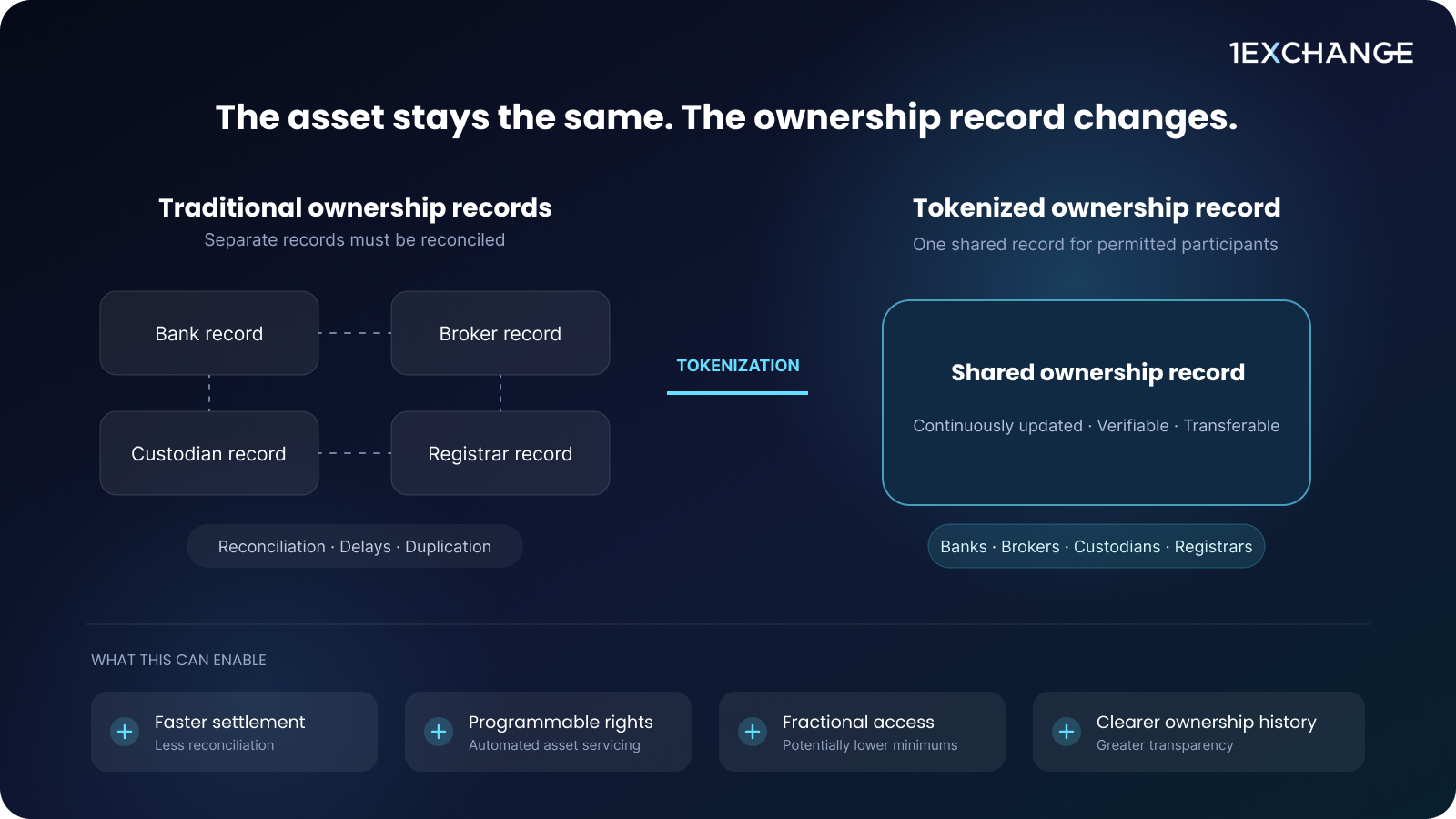
Much of the cost and complexity in capital markets comes from how ownership is recorded. Banks, brokers, custodians and registrars often maintain separate records that must be reconciled. A shared ledger can reduce this duplication and shorten settlement times, while smart contracts can automate transfers, dividends, redemptions and compliance checks.
Fractional ownership may lower investment minimums and broaden access to assets traditionally reserved for institutions. For issuers, tokenization can provide a more efficient way to raise capital and reach investors.
This is moving beyond experimentation. In 2025, DTCC’s depository subsidiary provided custody and asset servicing for securities valued at US$114 trillion. DTCC is now developing a tokenization service with more than 50 financial institutions, showing that tokenization is becoming a market-infrastructure story, not simply a crypto narrative.
Look Beyond the Label
The next time you see an investment which is described as an RWA, just ask yourself:
1. What asset sits underneath the token?
2. What rights does the token carry?
3. Who holds or administers the underlying asset?
4. Which ownership record is legally authoritative?
5. Where can the token be traded?
These questions turn “RWA Tokenization” from a buzzword into a practical way to understand ownership, market access and accountability.
Bringing Tokenized Assets to Market
Tokenization becomes meaningful only when clear ownership rights are supported by credible market infrastructure. This includes regulated venues where assets can move beyond issuance and enter secondary-market trading.
As a Recognized Market Operator regulated by the Monetary Authority of Singapore, 1exchange operates within this part of the ecosystem. Because the real measure of tokenization is not how many assets are brought on-chain, but whether investors can understand, access and trade them with confidence.
Disclaimer
The information contained in this article is provided strictly for general informational purposes only. It does not constitute financial advice, investment advice, an offer to sell, or a solicitation of an offer to purchase or subscribe for any securities or financial products listed or traded on 1exchange (“1X”).
Investments involve risks, including the possible loss of principal. Past performance is not necessarily indicative of future performance.
Readers should carefully consider their investment objectives, financial circumstances, and risk tolerance, and should conduct their own independent research. Where appropriate, readers are encouraged to seek advice from a qualified financial professional before making any investment decisions.
This advertisement has not been reviewed by the Monetary Authority of Singapore.